

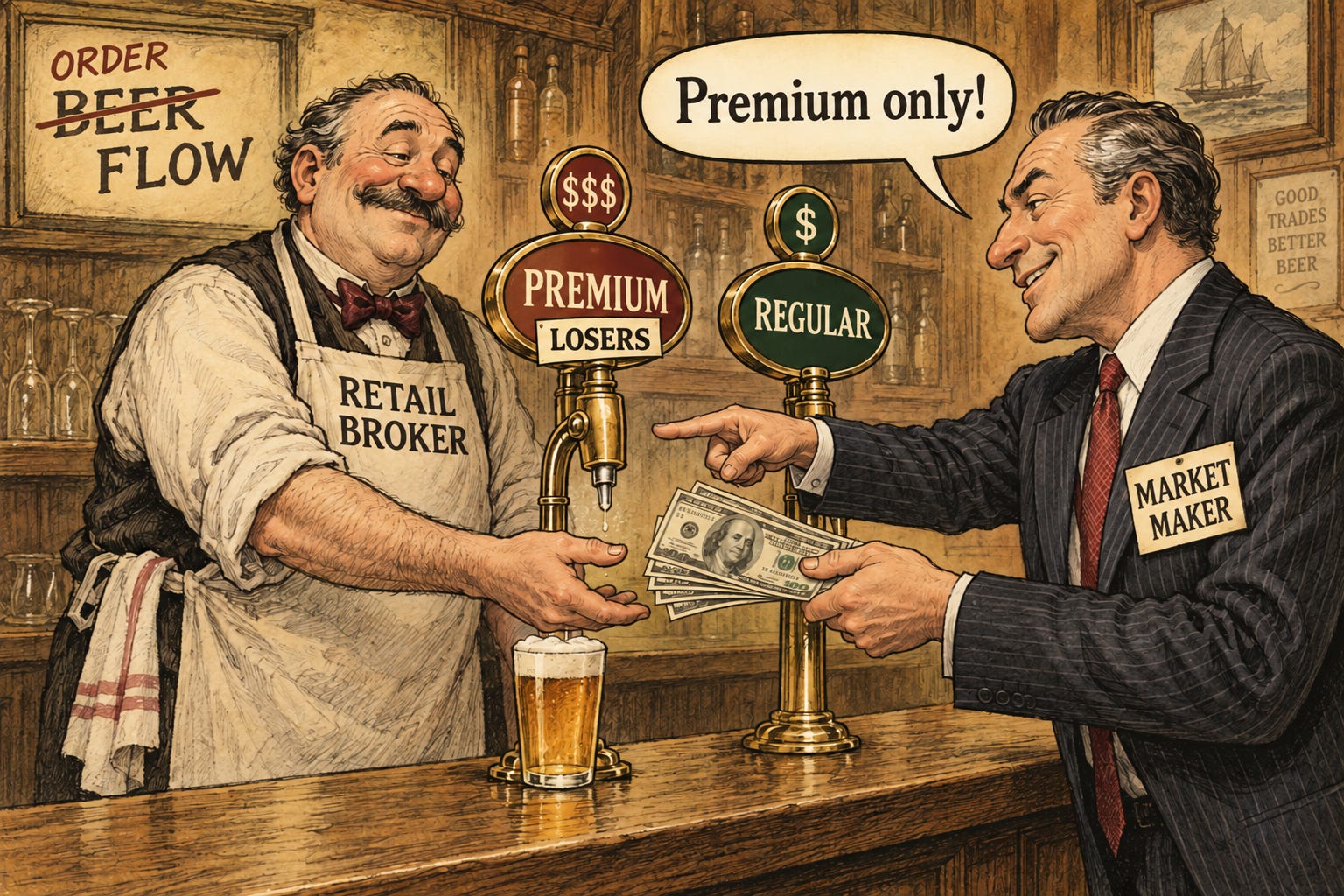
I first came across the order flow business as an HFT COO, when we were offered the chance to buy order flow from a retail broker, through an acquaintance of the CEO. Mind you, this was 2004—almost a decade before Robinhood was even a thought. I remember personally deciding to reject the proposal because it seemed shady. Of course I told the CEO it was a capacity issue—as one would.
Only much later did I find out I was in good company: the same year, 2004, Citadel told the SEC:
“The practice of payment for order flow creates serious conflicts of interest and should be banned.”1
We have come a really, really long way since then. By late 2005 Citadel had started its own retail wholesaling business. By 2017 it was executing about 35% of US retail share volume. And in Q2 2026 it paid Robinhood about $209 million.2 In just three months. Orderflow under the bridge, I suppose.
The origin story
“Some retail firms developed an idea that they had a commodity that was worth selling, and they took it out to the wholesale industry and said, ‘We have got some order flow here and we think it is worth something.’” So recalled a Nasdaq wholesaler at a 1989 SEC roundtable, describing how the business had taken off in the mid-80s.3
Ok, slow down, slow down. Selling what to whom, and why? Who are these wholesalers?
Actually quite simple to explain through three questions:
Who sells? The retail brokers sell their customers’ orders. Your orders!
Who buys? The market makers, referred to above as wholesalers.
Why do they pay? Because retail orders are, on average, uninformed. Remember the biggest nemesis of the market maker being the informed trader, and not knowing who is who? And that being the reason they needed to quote wider spreads?
In 1989, one of the best-known dealers4 in the business put a price on this commodity at that SEC roundtable: “We pay a penny a share for our order execution.” Back when the spread was 12.5 cents, a penny was a meaningful fraction of it. Today Robinhood says it gets 12.35% of the spread. For all that has changed, those fractions look remarkably constant.5
Hiccups
In 1992–94 there was regulatory pushback that almost saw a ban of the business practice altogether. “Business practice”, really, it is time to call it by its name already—Payment for Order Flow, or PFOF in short. The regulators eventually settled on “sunlight as the best disinfectant” for PFOF.6 A disclaimer instead of a ban, then, was the decision.
But, alas, there are more twists in this story. Next, the industry did what it does best: it adapted and spread. In 1999 options joined the party—within a year, specialists were paying for more than three quarters of the retail options orders sent to them.7 Then, in another twist, in 2001 decimals squeezed many stock spreads towards a penny, and the payments shrank with them. Less spread, less money to share—an existential crisis for PFOF folk.
But a penny spread still left room to work. Reg NMS, 2005: restricting sub-penny quotes whilst allowing sub-penny price-improved executions — was the salvation.8 The market maker could give you a fraction of a cent and still leave something for itself—and your broker. We were back in business.
By 2010, nearly all retail market orders at the big brokers went straight to wholesalers/ market makers.9 The show kept going on.
The modern PFOF packaging
Then came “free”. Robinhood launched in 2015, with order flow making up over 80% of its early revenue, paving the way for the famous cost-free trading revolution. By October 2019 the major US online brokers had followed it to zero commission on ordinary stock trades.10
Commission-free, yes, but is it really cost-free? The SEC put a number on Robinhood’s catch in 2020: its customers were $34.1 million worse off from inferior execution, even after counting the commissions they saved. Robinhood paid a $65 million penalty over misleading disclosures and best-execution failures.11 The new model was anything but settled.
Only in the wild wild west?
So the US chose disclosure over a ban, and the business continued unabated, and grew considerably with the free model. As Calvin Coolidge once said, “After all, the chief business of the American people is business.”12
But outside of the US this business was received differently. The EU banned PFOF in 2024; Germany, the only country that asked for extra time, got it until this summer. Australia prohibited it, and the UK has considered it all but incompatible with its rules since 2012. Though, as of this year, they are having another look.13
So are the US customers worse off? The cost-free trading headline was way too alluring to fully ignore elsewhere. Commissions generally remained outside of the US, though, just got smaller: a euro a trade at Germany’s Trade Republic, A$5 on a trade up to A$1,000 at Australia’s CommSec, no commission at all at the UK’s Trading 212.
And where the payment was banned, the money found another door. Trade Republic now executes its Best Price orders against its own book; Scalable itself makes markets on the European Investor Exchange. The broker can be the maker, too, you know. Problem solved.14 But isn’t that an even greater conflict of interest?
So, per trade at least, US customers came out ahead of most of their overseas counterparts — less thanks to the market than to the US regulators’ choice to allow it.
So all good, right?
After all, the benefits seemed to trickle down to the retail trader, and a big chunk of commissions disappeared. It is certainly true that a trade has become much cheaper. For the typical manual retail stock order, the commission is effectively zero, and the trade even gets price-improved. What is there not to like?
Nothing. I DO like that. And so should you.
But it is worth zooming out a little.
The commission is only part of the cost anyway. Take US retail options between November 2019 and June 2021: in one study’s sample, about $900 million in direct trading costs, against “a staggering $6.4 billion” paid in the spread.15 The trading outcomes were ugly, too. The options study estimated $2.1 billion in losses for retail traders over those same twenty months.
And perhaps even more importantly, the allure of easier access to trading, and the marketed free-ness of it, helped make trading much more widespread. Robinhood went from 5.1 million funded accounts at the end of 2019 to 18 million by March 2021. Its median customer was 31, and in its own words, “Many of our customers are first-time investors.”16 The options study estimated that retail accounted for over 60% of US options volume. And no, it isn’t only the free-ness: Robinhood users trade more on “attention” than other retail investors, driven “in part by the app’s unique features.”17 Let’s accept this at face value, because this claim doesn’t concern us now.
What does concern us, however, is that in 2021 alone, US brokers were paid $3.7 billion for their customers’ options and stock trades combined.18 And that is only what reached the brokers. Add that and then some to figure out how much the market maker profited on the same flow…
So yes, cheaper per trade. That is real progress, and I give it credit. But removing the commission does not turn a losing trading proposition into a winning one. Make that proposition easier to enter, more alluring, and easier to repeat, and you can scale the losses quite magnificently. Overall I would argue it did not get cheaper at all per trader, and worse yet for the retail trading space as a whole.
Free with caveats
So when does “free” apply? Open the app, tap buy, a few shares. Yes, that is commission-free. But step off that path and the price tag can come back.
And how about through an API? Sometimes. And where it is free, read the fine print. Alpaca built its whole business on commission-free API trading, yet “Alpaca reserves the right to charge additional fees if it is determined that order flow is non-retail in nature.”19 Want to avoid the makers and route directly to an exchange? Congrats, you have just forfeited your free option outright — back to venue fees and commissions like mortals.
Trading options a lot? Average more than 390 orders a day over a month and the exchanges reclassify you as a “Professional”.20 The priority and fee breaks reserved for public customers no longer apply in the same way.
None of this should surprise us. Your order was free because it was worth buying, and it was worth buying because, on average, it knew nothing. Toxic flow, remember? The free offering is built for retail flow. Start trading like a professional, and the terms can, and will change.
About democratization
Access—yes, it really has become democratized. But let’s look at some broad categories of trading, and how they stack up with the freebie proposition:
High-frequency trading—at the fastest end, not a chance in the world. Not free, not accessible that way. Full stop.
Day trading—opening and closing your positions within the same day, flat by the close. The brutal truth: retail traders in this space are hammered. In Taiwan, over fifteen years of data, fewer than 1% of day traders could predictably and reliably beat the market after fees.21 In Brazil, of those who stuck with trading mini-index futures for 300 days or more, 97% lost money.22
Active trading—active investment decisions with a holding period of a day or more. Even on the fund level, the passive ones have outperformed most actively managed funds. Some 79% of US large-cap active funds lagged the S&P 500 in 2025; over twenty years, 93% of them did!23 These are professionals, with research teams and institutional execution. Do we expect retailers to do better?
Investment-style trading—buy & hold. Yes, here commission-free access is very useful. Commissions were a big part of that drag. For ordinary US stock trades, they are now largely gone.
The conflict of interest Citadel flagged to the SEC over two decades ago is still present. And yet costs have moved in the right direction, and PFOF helped finance that change. I will happily give credit where it is due.
The problem, however, is the coaxing, the luring of the unaware crowd towards doing more of what even billion-dollar firms struggle to do well. So, as it has become my go-to parting message: more transparency from the industry could be a cure. Disclosures are great. But actively explaining what we have just gone over is unlikely to come from the very firms this “business practice” benefits directly.
So I try to illuminate as much of it as I can. And by reading and sharing this, you are doing it with me. Thank you!
An addendum — optional reading
For those of you wanting to understand more about whether retailers and brokers all get the same deal from the wholesalers: they don’t.
Not all wholesale is born equal
Between December 2021 and June 2022, a group of academics did what you’d think someone would have done long before. They sent the same small market orders through six accounts at five brokers, and compared the fills. Around 85,000 orders, roughly $100 each.24
Same stock, same moment, same size. Different price. Here is how much of the quoted spread each account got back as price improvement, on average:
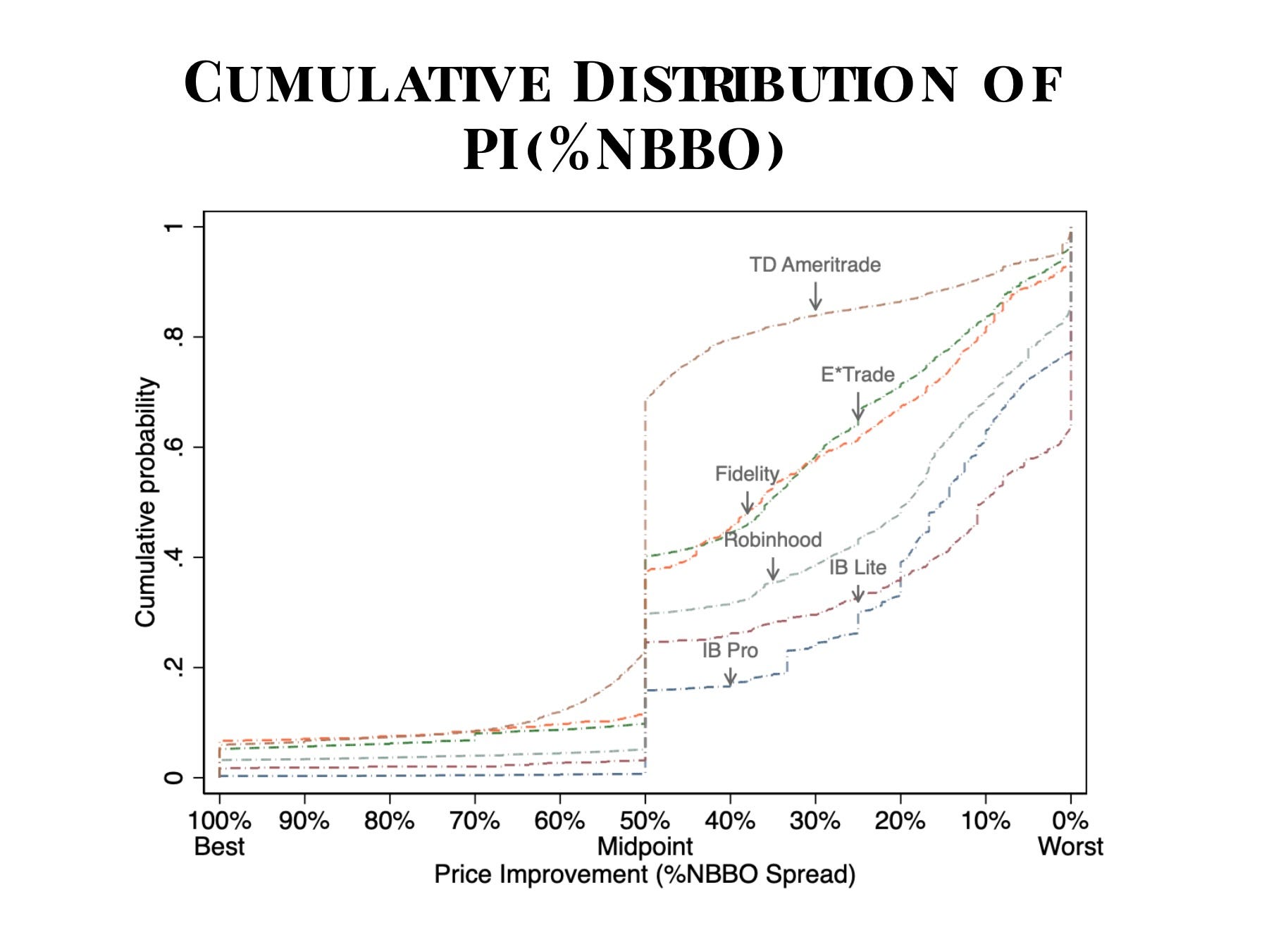
Execution experiment, 2021–22. Higher curves indicate better price improvement against the quoted spread.
Average round-trip costs ranged from 0.07% to 0.46%, depending on the account. Before commissions. The wholesalers were giving different brokers different prices for the same trades. And no, the differences in PFOF payments didn’t explain the gap.
From my seat, I would still want to separate the good trades from the bad ones. Did the improvement shrink exactly when the market was about to move against the maker? That is where the real money is. Averages are comfortable; the tails are where you live.
The good news: you no longer need 85,000 trades to start checking your own broker. Since August this year, large US brokers have to publish monthly execution-quality statistics under the amended Rule 605. Look yours up. Compare.
The bad news: stocks only. Options, which bring in about 72% of Robinhood’s order flow payments, get no such execution-quality report.25
Sunlight, finally. Just not in the shady alleys.
Citadel’s SEC letter, April 2004, concerning options-market structure.
SEC order, January 2017; quarterly payments from Robinhood Securities’ Q2 2026 routing report.
Herzog Heine Geduld’s account of the business’s beginnings, at the SEC’s July 1989 roundtable.
Bernard L. Madoff. Yes, that Madoff. Same roundtable.
Historical payments of 1–2¢ were 8–16% of a 12.5¢ spread. Robinhood’s reported regular-hours rate is 12.35%; extended hours differ. See its Q2 2026 routing report.
SEC’s 1994 disclosure rule. Disclosure did not replace best-execution obligations.
Regulation NMS, Rule 612, distinguished permissible sub-penny executions from prohibited sub-penny quotes.
SEC’s 2020 Robinhood findings, concerning misleading disclosures and best execution.
Coolidge’s January 1925 address.
EU: MiFIR Article 39a. UK: 2012 guidance and 2026 review plans. Australia: ASIC’s market-integrity rules.
Trade Republic’s Best Price model, Scalable’s EIX explanation, CommSec rates, and Trading 212 pricing. CommSec’s quoted rate requires settlement through its linked cash account.
Bryzgalova, Pavlova & Sikorskaya, Retail Trading in Options and the Rise of the Big Three Wholesalers, 2023. The loss estimate assumes ten-day holding periods; spread costs are measured against midquotes.
Robinhood Markets, Form S-1, July 2021.
Barber, Huang, Odean & Schwarz, Attention-Induced Trading and Returns: Evidence from Robinhood Users, 2022.
Same options study as note 15: in 2021, US brokers received $2.4 billion in payment for order flow on options and $1.3 billion on stocks.
Alpaca disclosures. Commission-free API trading has eligibility conditions and exceptions.
Cboe’s professional-order definition: more than 390 listed-options orders daily, averaged over a calendar month.
Barber et al., The Cross-Section of Speculator Skill, 2014. Taiwan day traders, 1992–2006. The finding concerns predictable positive abnormal returns after fees.
Chague et al., Day Trading for a Living?, 2020. Brazilian mini-index futures traders who persisted for at least 300 days.
SPIVA U.S. Scorecard, year-end 2025, Report 1a.
Schwarz et al., The “Actual Retail Price” of Equity Trades, 2025. Chart from the authors’ 2024 presentation. Experiment conducted in 2021–22; round-trip costs exclude commissions. TD Ameritrade accounts subsequently moved to Schwab.
Amended Rule 605, with compliance from August 2026. Covers qualifying stock orders, not options. Options’ payment share comes from Robinhood’s Q2 2026 routing report.