

For years I argued with my CEO about a single distinction: good trades versus bad trades. He classified every one of our trades into one or the other, whereas I thought the whole exercise was meaningless. Different traders have different holding periods, objectives, constraints — a trade that’s good for one book is bad for another. He’d argue back. I stayed unconvinced.
He was right. It took me years to understand why.
This was a man who once made me pick four Black Labels out of sixteen whisky glasses at the Christmas party to settle an argument about my taste — so disagreements with him were never boring. He was thirty years my senior and a finance professor at a top US university, so I should have caved. But as most people in their twenties do, I thought my arguments were bulletproof:
A buy trade good for an HFT is bad for a hedge fund. The HFT wants to close it for the slightest profit; the fund wants a double-digit return contribution to a huge portfolio. Surely their view of the same trade should differ — so there is no point in chasing universality.
The counter-arguments I received were mostly based in literature and authority, neither of which fazed me much.
Years of strategy development, strategy oversight, and trading system evaluation flipped my view completely. From inside a strategy, the window is fixed and the signals are frozen. My original argument was about evaluation after the fact — but strategies don’t jump back and forth in time to prove you right. They come with a fixed signal set, perhaps 57% winning and 43% losing by default. You could argue that some of the losers would be profitable if only you waited two hours or three days more. That is not this strategy, though. That is a different strategy altogether.
Once committed and deployed, what’s available is the now, not the future. Once you accept that, the only variable left is the price. This is actually an everyday intuition: “this was an absolute steal”, “a killer deal”, “the bargain of the century”. These expressions show the same awareness at the store. It’s all about the price. But somehow when we elevate ourselves into the heights of strategy development, we start looking for a more sophisticated take. On this one, the industry and academia have long sided with the common folk1. The overthinkers among us were in the wrong.
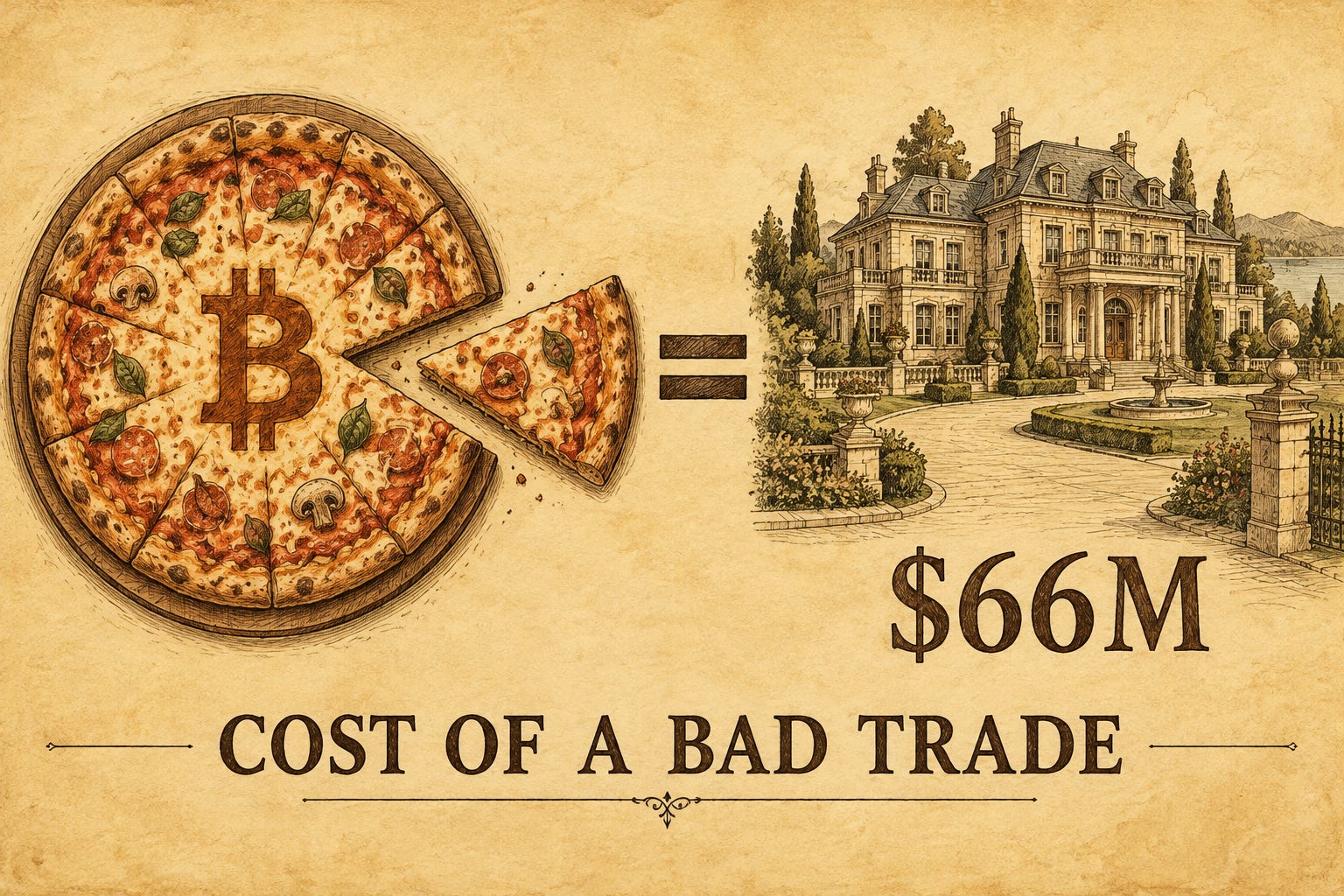
Surely, though, buying Bitcoin in 2010 is inarguably a good trade, you may say. A price tick here and there cannot make a difference in that determination. I hear you, but think of it this way. Imagine we are in early 2010, Bitcoin is trading at a cent2. You have $100, so you buy 10,000 Bitcoin. Happy days. Now, instead, you get it at a worse price — say 1.1 cents. You are left with 9,091 Bitcoin. At the approximate price at the time of writing, that means instead of $734 million on your $100, you would have only made $667.3 million. A $66.7 million difference between a good trade and a bad trade!
The trick lies in the freezing. You freeze the assumptions and accept the future as unknown. The trade was good or bad the moment it was executed. Everything after is just the outcome arriving.
The institutional execution world has measured trade quality this way for decades. André Perold’s 1988 paper The Implementation Shortfall: Paper Versus Reality formalized the idea: a trade’s quality is the gap between the decision price and the actual execution price plus costs. The discipline that grew out of it — Transaction Cost Analysis, or TCA — is standard on every sophisticated execution desk.
Bitcoin had no recorded market price until 2010, when it first traded for fractions of a cent. The famous 10,000 BTC pizza transaction in May 2010 implied roughly $0.0041 per coin.