

Enter the high-profile politician and his entourage. The chipmakers, the hyperscalers, the tech moguls — all in the room. On the table: should the new chip design go automatically onto the restricted-export list for China, and even for US allies? How much does this chip change the AI race? Someone glances toward the security detail at the door. “All sealed? No one listening?” Not a blink. The public announcement is still weeks off.
Over the next week, NVIDIA price drifts up. Nothing dramatic — no single trade you could point to, no name attached. A few accounts add on quiet days. By the time the ruling is public, the stock has already travelled most of the distance, and the announcement barely moves it.
Is that market efficiency?
The consensus view
The traditional story calls any price move that happens before public absorption “information acquisition,” and treats it as a sign of markets functioning correctly. The less the market jumps on such announcements, the healthier and smarter the market was to begin with.
This assumption is the basis of a subsequent discrimination. The process that helps this early absorption — the research that goes into predicting such information — is considered a force for good. The predatory HFT snipers that detect these footprints and erode such profits are cast as the malevolent actors: they rob the researcher of profits that would have gone into further honest research. So goes the story according to Weller, and many after him. He, in fact, plainly concludes that algorithmic trading reduces information acquisition — that HFTs harm price discovery1. A recent paper refines the story, arguing that it is the sniper HFT who is the malevolent actor, while the liquidity-providing kind is still a force for good2.
The problem with all of the above is that it assumes the early knowledge of future information was acquired completely honestly. Neither Weller nor those refining him mention insider trading — the politician, the entourage, the industry insiders, those who have been tipped off, those who have traded insider knowledge between them so that no single trade is traceable. Their arguments only work if the “illegitimate” share of knowledge acquisition is effectively zero. But is this really the case?
The ugly reality
It is not, and the evidence is not hard to find.
In the options market, informed trading ahead of public announcements is a measured fact. In a study of 1,859 US takeovers, roughly a quarter showed abnormal options activity before the deal became public — concentrated in short-dated, out-of-the-money calls, the cheapest way to bet on a jump you already know is coming3. Over half of that activity could not be explained by speculation, rumor, corporate-insider filings, or any other legitimate source. So: suspicious informed trading in a quarter of deals, roughly half of it unexplainable — and the SEC litigated about 8% of the deals in the sample. The overwhelming majority is never touched. And that is likely only scratching the surface.
The same pattern is visible in plain sight in Congress. In 2024, dozens of members — from both parties — outperformed the S&P 500, which returned about 25%. Nancy Pelosi’s disclosed portfolio was up roughly 71%; she has defended the practice as participation in a “free-market economy.” Tommy Tuberville and Marjorie Taylor Greene have been among the most actively tracked traders on the Hill, their timing repeatedly flagged against the committees they sit on. Ro Khanna, who leads the push to ban congressional trading, doesn't trade himself — his wife's trust is among the most active in Congress, and the bills he has championed stop at the member. The bill that passed the House yesterday does finally cover spouses4; it also lets everyone keep what they already hold. Around a hundred members trade actively, and year after year a substantial share beat the market they help write the rules for. The names span both parties, both chambers, and most committees. This is not name slinging, or if so, it is slinging both ways.
Now hold that number against everyone else. When honest retail traders do the research themselves, the results are brutal: across the largest studies — the entire Taiwan Stock Exchange over fourteen years, every new day trader in Brazil over several years — around 80% lose money, and fewer than one in a hundred is consistently profitable5. Research, it turns out, is hard; that is what the data says about people actually doing it. Yet a body of roughly a hundred people who happen to write the policy hits about 50% success rate. The parsimonious explanation for that gap is not that legislators are eighty times better analysts than everyone else. It is that they are doing something else.
The failed assumption
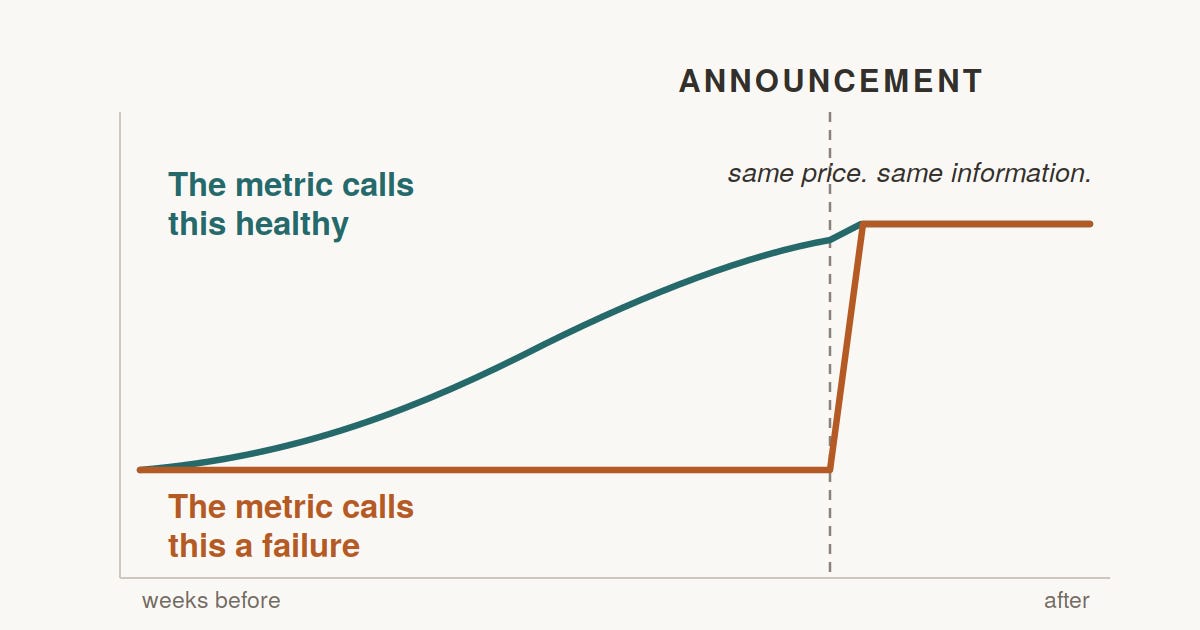
Since the dishonest share of information acquisition is not zero, the labelling and the moralizing should also not be absolute. Whether the early move comes from a genuine research finding inside Fidelity or from the nephew of a Congressman’s driver, the price absorption is indistinguishable. It turns out that when the sniper HFT erodes this illegally obtained advantage, he may actually be doing the market a favour. In this case it is a tax on the insider.
And it is not only the sniper the metric mislabels. For insider trades, the price is not supposed to move until the announcement. So the unmoved price the papers call a failure is exactly what should happen. The jump, when it comes, is the correct outcome — not a sign the market was slow, but the opposite.
The failure of the moral lens
Don’t mistake me — I am not saying that insider trading is fine; it should just be absorbed differently. Nor am I saying that HFTs are somehow redeemed from any wrongdoing.
My issue is that the literature has completely disregarded an inefficiency in the “real world” that redefines the problem right from the get-go: the reality of insider-like trading. On the HFT question I do believe researchers have set out to decide, empirically, whether HFT is good or bad. And in that quest they have forgotten to check their assumptions fully.
As with everything, we should not try to decide whether HFT is good or bad, but whether certain practices are useful or not, and if so to what extent.
The only practice that can be condemned outright is the insider-like trading — unambiguously, and in a bipartisan way.
Weller, Brian M. (2018). “Does Algorithmic Trading Reduce Information Acquisition?” The Review of Financial Studies, 31(6), 2184–2226.
The clean distinction between liquidity-providing and sniping actors only works in papers; in reality most HFT firms do both. The paper making this distinction: Ibikunle, Gbenga; Moews, Ben; Muravyev, Dmitriy; Rzayev, Khaladdin (2024). “Data-Driven Measures of High-Frequency Trading.” arXiv:2405.08101 (working paper).
Augustin, Patrick; Brenner, Menachem; Subrahmanyam, Marti G. (2019). “Informed Options Trading Prior to Takeover Announcements: Insider Trading?” Management Science, 65(12), 5697–5720.
The House voted yesterday to bar members, spouses and dependent children from buying new stocks; existing holdings are grandfathered, and the Senate is unlikely to take it up. It also does nothing about the thirteen years of data the research is built on.
It is also a far cry from actually stopping trading favors, donations in / trading advice out, quid pro quo. Worse yet, the actual ban had been in place for 13 years already, and never once been enforced.
Barber, Brad M.; Lee, Yi-Tsung; Liu, Yu-Jane; Odean, Terrance (2014). “The Cross-Section of Speculator Skill: Evidence from Day Trading.” Journal of Financial Markets, 18, 1–24 (Taiwan; ~80% of day traders lose net of costs, <1% consistently profitable). See also Chague, Fernando; De-Losso, Rodrigo; Giovannetti, Bruno (2020). “Day Trading for a Living?” (SSRN working paper; Brazil; 97% of traders persisting beyond 300 sessions lost money)