

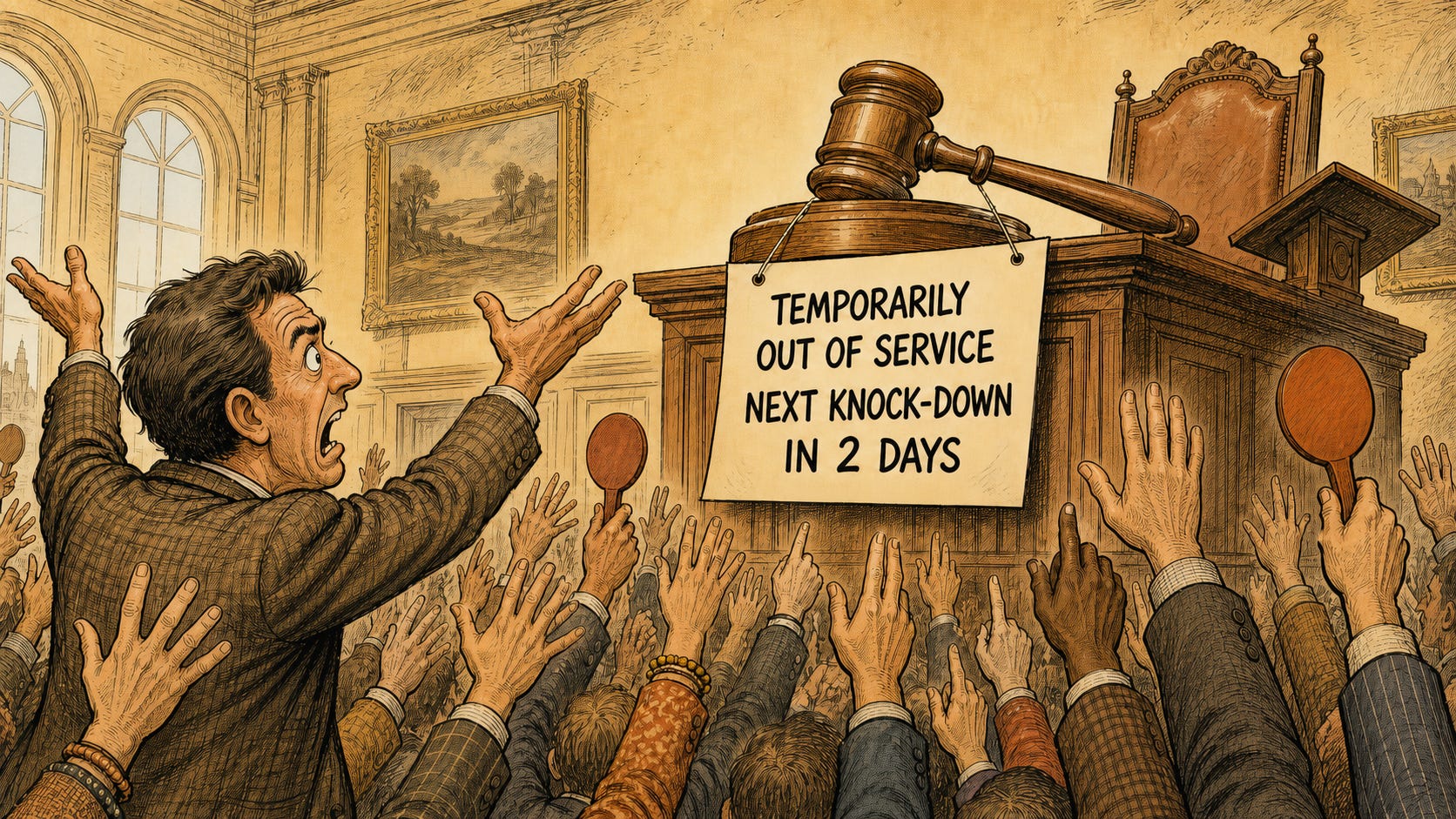
Batch auctions were introduced so that the poor, forlorn, unguarded trader – connected via patchy internet connection on his laptop, sitting at the beach across the globe from the trade server – be protected from the caprice of the cruel low-latency arms race by the HFT-enabled giants.
A noble goal. But does the beach trader actually come out ahead — or does someone else?
Where do we start… So what are these batch auctions, anyway?
Very simple, just imagine an auction that:
happens at regular intervals,
accumulates all order intent since the last interval, and
uses a mechanism to match them in this combined order book.
The idea is that everyone in the batch gets the same clearing price, and when your order arrived within the window doesn’t matter — so being faster buys you nothing.
And the talk of the town is that this is much more “fair” than continuous trading.
In fairness – pun intended – before I take this apart: sniping stale orders by faster players, and certain crypto-adjacent order reordering machinations, are real, and do indeed need a resolution. These make the markets less efficient, and admittedly less fair. There is respectable literature that describes this effect1, so it is far from being a crank idea. Attempts to make this a reality are ongoing, both in the DeFi (decentralized finance) and TradFi (traditional finance) space, with various degrees of success. More on those later.
Cost #1
The more astute of you would have already wondered: “What happens between these auction intervals?” That is the point. Between the auctions these markets simply don’t provide any trading price. On closer scrutiny this is NOT such A SMALL DEAL. One of the key services that an exchange provides is immediacy. And that immediacy is liquidity. Not being able to trade for 1 second, or even 100 milliseconds means that there is effectively no liquidity for that period. Even if there is ample depth available in reality. Everybody waiting for a price, instead of already pricing their model to value risk, or prepare the exit.
Cost #2
Worse yet, this means that in this no-man’s-land, no-man’s-time, and no-man’s-price the venue needs to import a price from continuous trading.
Do we really think a venue running a batch auction for Bitcoin can make do without a super-connection to Binance in the 100millis? So it is but a quasi continuous-exchange wearing a closing-cross costume (another auction-based mechanism).
So these types of batch auction venues structurally depend on the thing they claim to replace — prices from continuous trading.
Ultimate Cost: the arbitrage comes home to roost
Let’s assume the batch auction was done and the price cleared fairly. The arbitrage we are so worried about — gained in fistfights for nanoseconds in datacenters and microwave towers, for an opportunity no mortal could ever capitalize on — is gone. Yes; inside the window.
But the asset never stopped trading everywhere else. The moment your batch clears, there are two prices: the one you just printed, frozen a beat ago, and the live one out there, already moved. The gap between them is an arbitrage — the exact creature you built the auction to kill.
You didn’t RE-move it. You MOVED it — from inside the book to the venue boundary. Where what matters is knowing the batch price a fraction before anyone else.
And who knows it first? Who watches the book fill? knows the instant it clears? sits at zero distance from the engine?
The venue itself.
It is like bringing a wolf to guard the hens from the foxes.
Real-life examples
Enough theory. There are real markets that have run this experiment, and there is one that runs it every single day without anyone objecting. Both are worth looking at, because they tell you exactly where a batch auction belongs — and where it doesn’t.
Taiwan
The Taiwan Stock Exchange ran periodic call auctions as its main mechanism for years2. Between 2010 and 2014 it cut the auction interval four times, from 25 seconds down to 5. An actual natural experiment. Almost no modern market ever ran frequent batching in the HFT era, so there is very little real evidence to argue over — most exchanges went continuous back in the nineties, before any of this was a question.
What did they find? As the interval shrank, market quality improved — liquidity, efficiency, the lot. Each step toward continuous made things better.
There is one finding cutting the other way: in thin, illiquid instruments, batching helped.
But look closely at what that actually says. First, the direction. Every step in the Taiwan experiment was toward continuous — 25 seconds, then 5, then the suggestion of 2 — and quality improved at every step. The limit of that sequence is continuous trading. So “more frequent batching is better” is just a quiet way of saying “the closer you get to continuous, the better it gets.” That is not evidence for the batch.
Second, the illiquid case. The benefit there is a coordination benefit — you are helping buyers and sellers who would never otherwise be present at the same instant to find each other. A very slight effect. But still.
So why this doesn’t score points for the batch auction case? HFTs are not in those thin names in the first place. There is no flow to snipe, no volume to justify the microwave towers.
Opening and closing auctions
On paper there is a fact that cuts against my argument: every major exchange already uses a batch auction. Twice a day – at the open and at the close.
So why does this happen? Because those are the two moments when immediacy is not what anyone wants. They want a coordinated price.
At the open, there has been no trading for hours; there is no price; a mass of overnight orders arrives at once and needs to be aggregated into one fair number.
At the close, thousands of participants — index funds, ETFs, market makers — all want the same price, in size, at one instant. Neither of those is a moment for trading now. They are moments for coordination, and a batch auction is the right tool for that.
So the market already ran the experiment and drew the boundary: a batch auction at the two moments immediacy doesn’t matter, and continuous trading for the entire session in between, when it does. Notice too that the closing cross works precisely because a full day of continuous trading happened behind it to discover the price. A market that is nothing but crosses has nothing to anchor to.
The opens and closes are not proof that batch auctions work as a market. They are proof that batch auctions work in their niche — and the frequent-batch proposal is just dragging them out of it.
The crypto ones
The one place batch auctions have actually been built out at scale, in anger, is crypto — and it is worth a look, because this is going on out there now “in the wild”.
On a public blockchain your trade sits in a visible waiting room before it settles, and whoever assembles the block decides the order it will execute in. The classic exploit is the sandwich: a bot sees your buy sitting there, buys just ahead of you, lets your order push the price up, and sells just behind you. You get the worse price; the bot keeps the difference. This is the sniping problem, and it is worse than in traditional markets, because the party ordering the trades can be the one exploiting them3.
So crypto did the obvious thing and built batch auctions to stop it — collect orders, clear at one price, kill the ordering game. And in doing so it walked straight into the operator problem I’ve been describing. On-chain, whoever sequences the batch is the natural extractor. The wolf, guarding the hens. There is even an extra layer: the operator can sell the ordering advantage rather than use it, which changes who extracts but not whether it gets extracted.
Still I withhold any judgement for now: whether these mechanisms net-improve things is not cleanly measured yet. The crypto world is mid-experiment, the results are not in, and there are genuine attempts to claw the value back and hand it to the trader — a story for another day4. But the direction is already visible, and it is the same direction: the edge does not disappear. It moves to whoever runs the venue.
So, does it guard, or does it pocket?
The speed race was never a bug you could design out. It was the market pricing a scarce thing — immediacy, and the right to be first to new information. You can freeze time into windows and abolish the race inside them. You can’t kill the advantage, though, just transfer — somewhere you can see it less, and trust it less.
So the trader on the beach is still on the beach. We moved the giants from the datacenter next door to the front desk.
The wolf now has the keys to the henhouse. We’ll count the hens later.
So far the tally looks daunting.
Eric Budish, Peter Cramton & John Shim, "The High-Frequency Trading Arms Race: Frequent Batch Auctions as a Market Design Response," Quarterly Journal of Economics 130(4), 2015, pp. 1547–1621. The paper this piece argues with — it makes the case that continuous limit-order-book trading is a flawed design and proposes batch auctions as the fix.
On the call-auction-versus-continuous evidence, see the work on the Taiwan Stock Exchange's staged reduction of its auction interval and subsequent move toward continuous trading. (e.g. Chung, Lee & [Twu/Wang], "Call auction frequency and market quality: Evidence from the Taiwan Stock Exchange," Journal of Financial Markets / ScienceDirect (S1049007818300319); Yi-Tsung Lee, Roberto Riccò & Kai Wang, "Frequent Batch Auctions vs. Continuous Trading: Evidence from Taiwan" (SSRN 3733682; published version ScienceDirect S1386418126000376))
Philip Daian et al., "Flash Boys 2.0: Frontrunning, Transaction Reordering, and Consensus Instability in Decentralized Exchanges," 2020 IEEE Symposium on Security and Privacy, pp. 910–927 (arXiv:1904.05234). The canonical academic treatment of MEV / on-chain front-running.
On the attempt to return extracted value to traders, see the order-flow-auction / backrun-rebate literature — e.g. MEV Blocker and CoW Protocol in practice, and Andrea Canidio & Robin Fritsch, "Arbitrageurs' profits, LVR, and sandwich attacks: batch trading as an AMM design response" (arXiv:2307.02074).